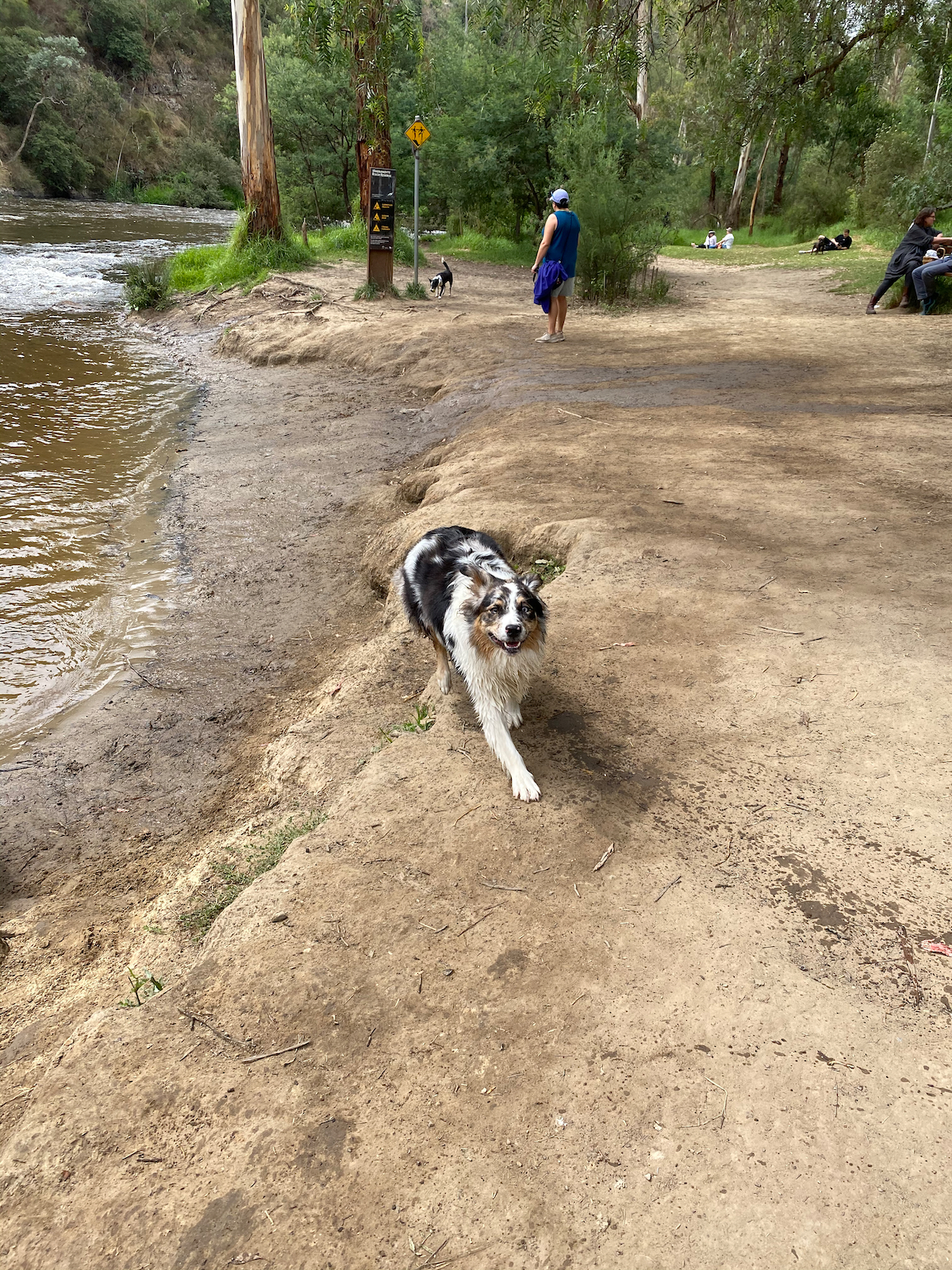
We’ve all seen this at the park.
Cooper is having a blast running around with his friends. But his owner wants to go home. She calls his name.
“Cooper!”
Cooper continues to romp with his friends.
“COOPER!”
Cooper hasn’t even flicked an ear.
“COOOOPER!!”
Cooper isn’t planning on coming back any time soon.
It’s going to take his owner a long time to get Cooper back on lead and into the car!
The problem isn’t that Cooper doesn’t know his name. It’s that he’s learned that responding to it isn’t worth leaving what he’s doing.

For humans, names are connected to identity and relationships. We use them a lot, and for all sorts of reasons:
- to identify someone: “Hi Katia!”
- to get someone’s attention: “Hey Emma! Check this out!”
- to interrupt behaviour: “Frida, stop that!”
- to reassure: “I hear what you’re saying, Malik”
- to express disgust or frustration: “Ew, David!”
- to congratulate: “Well done, Maya!”
Tone and context help humans understand what the other person means.
Dogs don’t communicate in quite the same way, but we often use their names as though they do. We say our dog’s name to get their attention, to show affection, to interrupt them, to reward them, to tell them to stop doing something — and sometimes to tell them off.
That can make a dog’s name very confusing.
If your dog’s name regularly predicts food, play, affection, another chance to go and explore, or something else they enjoy, responding to it makes sense.
But if their name regularly predicts:
- Don’t do that!
- Stop!
- You’re in trouble!
- Give me that!
- Playtime is over!
- Come here so I can put your lead on and take you home!
…coming back starts to look like a much less appealing option.

If hearing their name and returning to you usually means “party’s over,” your dog will become more and more reluctant to come back at all.
So Cooper isn’t necessarily being stubborn or deliberately ignoring his owner. From his point of view, staying with his friends may simply be a much better option than responding to a cue that usually means the fun is over.
The good news is that you can turn this around.
By being much more deliberate about how you use your dog’s name — and what happens when they respond to it — you can teach your dog that their name is worth listening to.
So let’s look at how to turn your dog’s name into one of the most powerful tools you have.
What does your dog’s name really mean to them?
Every time your dog’s name predicts something unpleasant or the loss of something they value — being told off, losing a toy, having the lead clipped on, leaving their friends — you risk making their name a little less valuable.
Over time, a cue that has repeatedly become associated with unpleasant or unwanted consequences can even become what trainers call a poisoned cue.
A poisoned cue is a cue or signal that the dog has learned to associate with something unpleasant, stressful or unwanted. Instead of predicting a rewarding outcome, the cue may create hesitation or conflict, making the dog less likely to respond.